Beware of cheap underperforming clones

As of 2023 there are many badly performing clones on the market. V2/3GHz NanoVNA uses parts like ADF4350 and AD8342 which are costly and clones have been cutting costs by using salvaged or reject parts.

See official store and look for V2 Plus4/V2 Plus4 Pro versions only to avoid getting a bad clone. We have stopped selling V2.2 versions since October 2020, so all V2 hardware that are not Plus or Plus4 are not made by us and we can not guarantee performance.

NanoVNA V2 Forum

Note: this page is a mirror of https://groups.io/g/NanoVNAV2.
Click here to join and see most recent posts.

Saving S21 delay


chris.fuller 2025/12/03 10:59

The nanovna is able to measure a calibrated S21 delay, but has anyone been able to find a way to save the measured S21 delay to memory or using the VNA-QT software?

Note that saving S-parameters or impedances does not save the S21 delay which is in units of nanoseconds (for example).

The S21 delay is not the same as time-to-fault as the S21 delay is a one-way delay and it is the delay from a 50 ohm port to another 50 ohm port.  The time-to-fault is a two-way delay from a 50 ohm port to a short or open.

In keysight/HP VNA's, the S21 delay is often saved as a .CSV file.

Thanks for any help!

Sincerely,
Chris
Jim Lux 2025/12/04 05:41

I think, for the NanoVNAs in general, there’s only one file format, basically .s1p or .s2p. (well, and screen shots as .png)

One can convert to time domain in software (doing the FFT, etc.) I would imagine that NanoVNA-Saver can do it (it can certainly read a .s2p and display it in time domain, whether it can save a .csv of time domain, I don’t know for sure. )

That’s sort of the tradeoff between inexpensive limited function device and big iron lab box. (Yeah, a FieldFox can save .csv, and it’s not big iron, literally, but it’s priced like big iron)


Glenn n6gn 2025/12/04 05:55

Chris,
Maybe not exactly what you are after but I have used Scikit-rf (Python library) to import 2-port S-parameters, convert to time domain, plot S21 v time,  perform time gating, plot gated/windowed response  and then return to frequency domain.  Of course, complete time detail is available doing it this way.

Write me if you'd like a Jupyter Notebook that does this.

Glenn n6gn

Glenn n6gn 2025/12/05 06:42

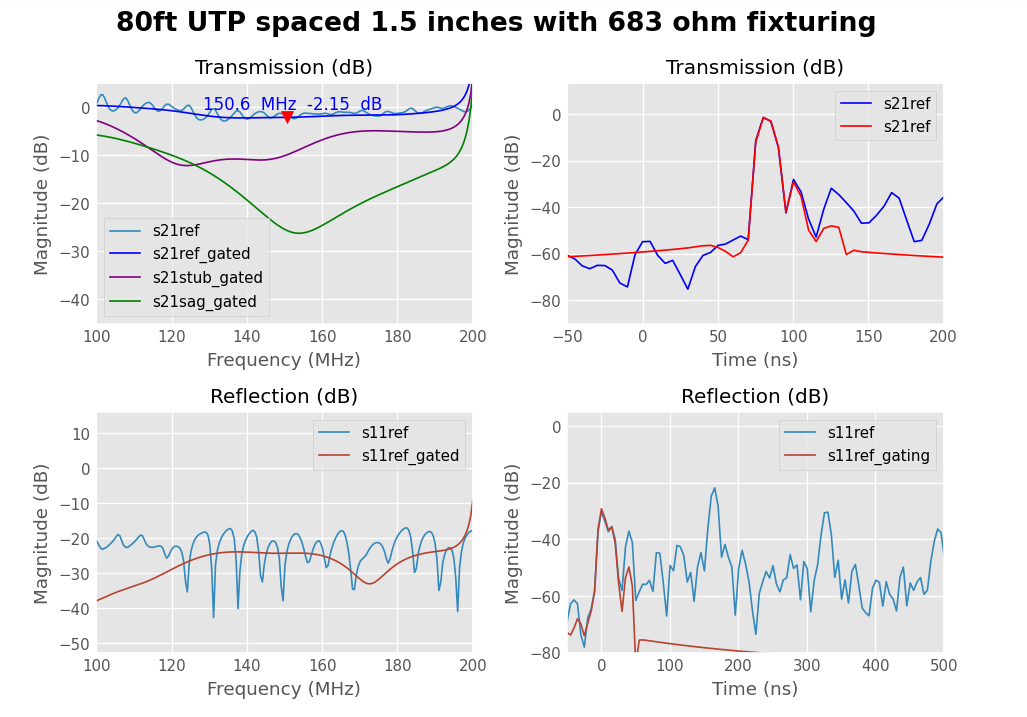
Here's an example of  data taken with a nanoVNA-v2-plus4 run through that kind of analysis.  DUT is about 25m of CAT5 conductor, untwisted and spaced about 4cm.
Top row is transmission without (blue) and with(red) time gating in the upper right.    Bottom row is S11 with the same color scheme.
You can see  the effect of removing unwanted terms due to (re)-reflection.

I can supply a Jupyter notebook page that performs this on measured data as well as a TRL calibration tool that I mentioned in a different thread.
As Jim ( https://groups.io/g/NanoVNAV2/topic/116605331 ) mentioned it does somewhat  "put a PNA in your pocket" on a nanoVNA budget.

Glenn n6gn

Jim Lux 2025/12/05 14:12

FWIW NanoVNA-Saver uses scikit-rf. Scikit-rf is wonderful. It does network
chaining and composition, has built in calibrations of all kinds of manner,
and decent plotting.

If you have a bit of Python expertise, it lets you crank out all kinds of cool
stuff.

You don’t need to be a Python expert.. I sure wasn’t when I started using it.


> On Dec 5, 2025, at 03:59, Glenn n6gn via groups.io
<n6gn=sonic.net@groups.io> wrote:
>
>

> 

>

> Chris,

>

> Maybe not exactly what you are after but I have used Scikit-rf (Python
library) to import 2-port S-parameters, convert to time domain, plot S21 v
time, perform time gating, plot gated/windowed response and then return to
frequency domain. Of course, complete time detail is available doing it this
way.

>

>
>

> Write me if you'd like a Jupyter Notebook that does this.

>

>
>

> Glenn n6gn

_._,_._,_

* * *

To reply to this topic, join https://groups.io/g/NanoVNAV2

View this thread on groups.io