⚠️ Beware of underperforming clones

As of April 2026 there are many badly performing clones on the market. V2/3GHz NanoVNA uses parts like ADF4350 and AD8342 which are costly and clones have been cutting costs by using salvaged or reject parts.

See official store and look for V2 Plus4/VNA6000 series only to avoid getting a bad clone. We have stopped selling V2.2 versions since October 2020, so all V2 hardware that are not Plus or Plus4 are not made by us and we can not guarantee performance.

NanoVNA Software Downloads

Expand the capabilities of your NanoVNA by connecting it to your PC, Mac, or Linux machine. Use professional software for high-resolution sweeps, data logging, and Touchstone (.s1p, .s2p) export.

NanoVNA-QT and NanoVNA Saver are the two PC applications for the NanoVNA series, and both are supported by NanoRFE hardware. You can download the software and drivers here.

USB Drivers & Connectivity

The NanoVNA series uses a USB-CDC interface. Most modern operating systems handle this automatically, but older versions of Windows may require manual installation.

NanoVNA-QT

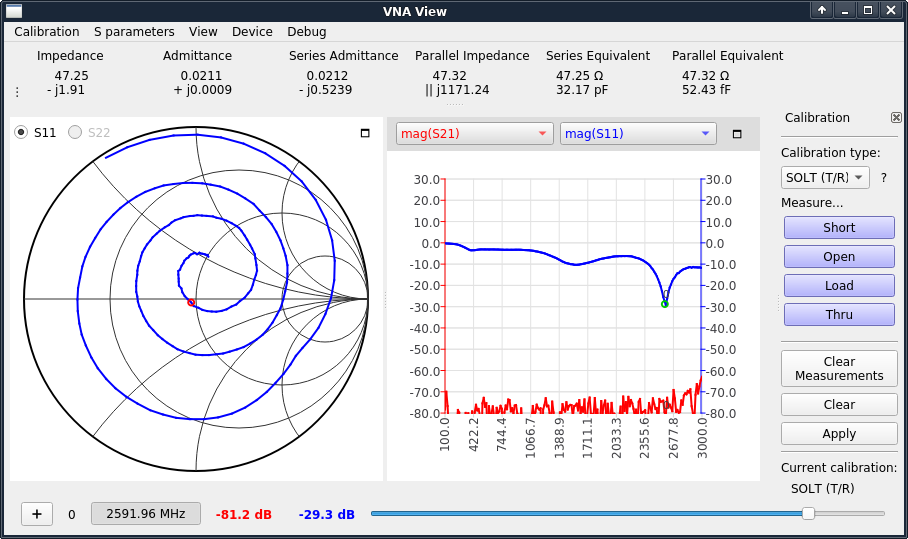
NanoVNA-QT (also known as VNA View) is the native application developed by NanoRFE, offering the most stable performance and highest data throughput. It is the recommended choice for users who require laboratory-grade stability and full support for the latest VNA6000 and V2 Plus4 features.

You may use the "mock device" feature (under the Device menu) to try the software prior to buying a VNA.

Features:

  • Visualizations: Smith chart, LogMag, Phase, Impedance, and VSWR plots.
  • Real-time: Live measurement and continuous display updates.
  • Custom Calibration: Full support for custom calibration kit parameters.
  • TDR Analysis: Specialized "Distance to Fault" and time-domain views.
  • Port Extension: Allows correcting for cable length/phase shift after calibration.
  • Developer API: C/C++ API for raw S-parameter data access and automation.
  • Export Options: 1-port/2-port S-parameter (Touchstone) and CSV file export.
  • Data Logging: Automated, continuous data export for stability monitoring.
  • Compatibility: Supports all NanoRFE NanoVNA hardware versions.

Screenshots:

screenshot screenshot

Download NanoVNA-QT v1.1 (Latest)

Linux (64-bit):
Download AppImage
Linux (32-bit):
Download AppImage

Older versions


NanoVNA Saver

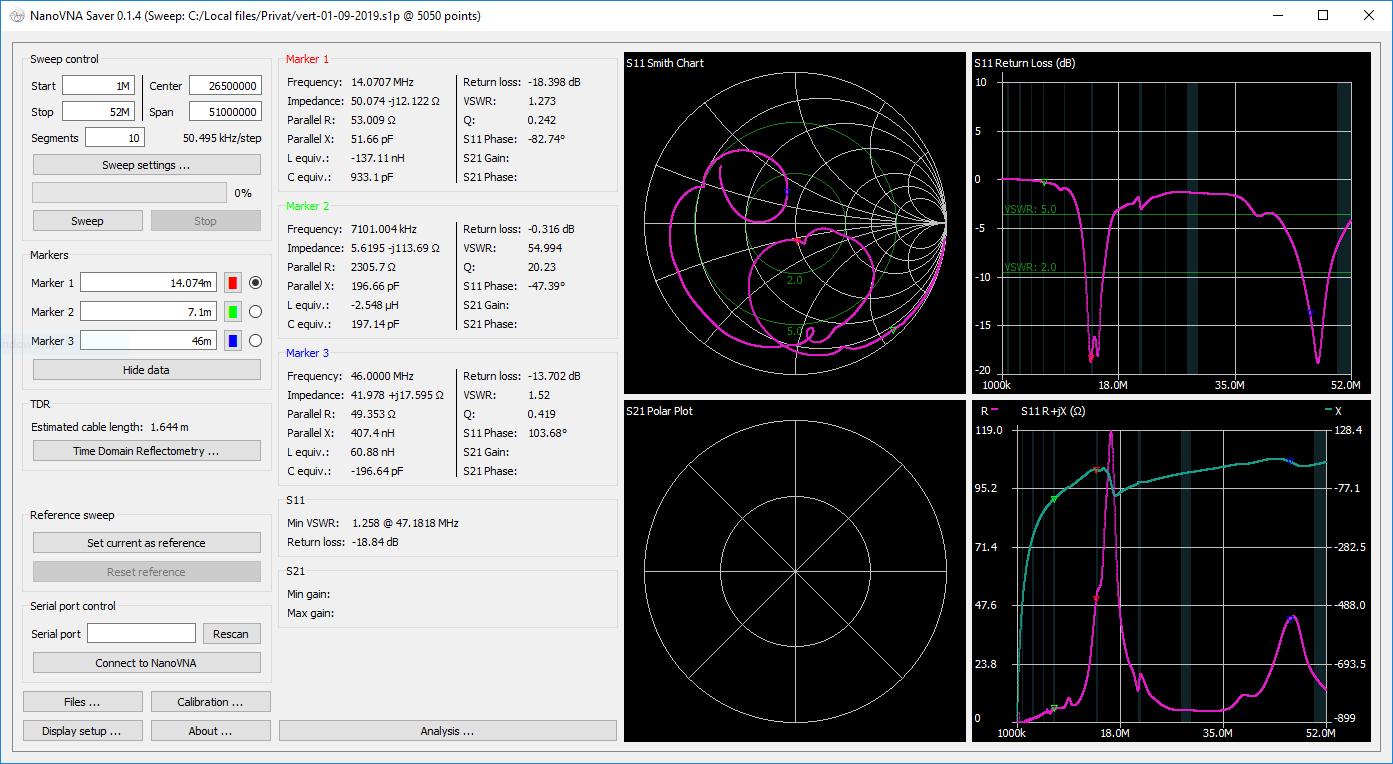
NanoVNASaver is developed by Rune B. Broberg. It is a multiplatform tool to save Touchstone files from the NanoVNA, sweep frequency spans in segments to gain more than 101 data points, and generally display and analyze the resulting data.

This software connects to a NanoVNA and extracts the data for display on a computer and allows saving the sweep data to Touchstone files.

The software was written in Python on Windows, using Pycharm, and the modules PyQT5, numpy, scipy and pyserial. Main development is currently done on Linux (Mint 20.3 Cinnamon)

Current features:

  • Reading data from a NanoVNA - Compatible devices: NanoVNA V1 and V2 series
  • Splitting a frequency range into multiple segments to increase resolution (up to >10k points)
  • Averaging data for better results particularly at higher frequencies
  • Displaying data on multiple chart types, such as Smith, LogMag, Phase and VSWR-charts, for both S11 and S21
  • Displaying markers, and the impedance, VSWR, Q, equivalent capacitance/inductance etc. at these locations
  • Displaying customizable frequency bands as reference, for example amateur radio bands
  • Exporting and importing 1-port and 2-port Touchstone files
  • TDR function (measurement of cable length) - including impedance display
  • Filter analysis functions for low-pass, high-pass, band-pass and band-stop filters
  • Display of both an active and a reference trace
  • Live updates of data from the NanoVNA, including for multi-segment sweeps
  • In-application calibration, including compensation for non-ideal calibration standards
  • Customizable display options, including "dark mode"
  • Exporting images of plotted values

Screenshots:

screenshot screenshot

Windows 7

Requires Service Pack 1 and Microsoft VC++ Redistributable. For most users, this would already be installed. Windows versions older than Windows 7 are not known to work.

Download NanoVNA Saver v0.6.2

Windows 64-bit (.zip) Linux Executable

New in v0.6.2

  • PyQt6 fixes
  • Add option --auto-connect, connect automatically if one device detected
  • Correct some inconsistencies in the UI
  • 3rd party library updates

Older versions

Downloads also available from GitHub

Using NanoVNA-QT (Official Software Guide)

NanoVNA-QT (VNA View) is the official, native PC software recommended for the NanoVNA V2, V3, and VNA6000 series. It offers fast sweep rates, raw data extraction, and a clean interface. Below is a quick start guide to making your first measurements.

1. Connecting to Your Device

After connecting your NanoVNA to your PC via USB, it will appear as a virtual serial port.

  • Open NanoVNA-QT and click on the Device menu at the top.
  • Select your device from the drop-down list (e.g., COM3 on Windows or /dev/ttyACM0 on Linux/Mac).
  • If you get an error, you may need to go to Device > Other and manually enter \\.\COMx (where x is your port number).
  • A continuous sweep will start immediately, and you will see actively updating data on the Smith chart and line plots.

Note: Windows 10/11, macOS, and Linux natively support the USB CDC class. If your device doesn't show up on older Windows OS versions, you may need to install the Cypress USB Serial driver.

2. Navigating the User Interface

  • Smith Chart Display: Shows a Smith chart of S11 or S22 depending on your selected radio button.
  • Line Graph Display: Displays a plot of two user-selected traces. Use the drop-down menus above the graph to select your data source (the trace color matches the drop-down color).
  • Calibration Pane: Found on the right side, this pane allows you to measure calibration standards and toggle error correction.
  • Impedance Display: Shows exact impedance values and series/parallel equivalent circuits calculated from S11.
  • Markers: Click the "+" button to add a new marker. Adjust the slider to move the marker along the sweep. Labels will show the exact numeric value at the current frequency.

3. Setting Sweep Range & Parameters

Before calibrating or measuring, you must define your frequency range.

  1. Go to Device > Sweep parameters... in the main menu.
  2. Set your Start frequency and Stop frequency.
  3. Set Frequency points (the number of discrete points you wish to sweep).
  4. Under Advanced Settings, you can adjust nValues. This controls the number of data points per sweep point to average over. A higher averaging factor reduces noise but increases sweep time.

Note: For the NanoVNA series, "Output power" and "nWait" settings in this menu are not applicable and are ignored by the hardware.

4. Performing a Calibration

Calibration must be performed whenever the frequency range is changed. Changing the sweep range automatically clears the active calibration.

  1. Reset the current state by clicking Clear and Clear Measurements in the Calibration pane.
  2. Select your Calibration type: Choose SOL (1-port) to correct for S11 only, or SOLT (T/R) for S11 and S21 response.
  3. Attach an SMA cable to Port 1 (and Port 2 if using SOLT).
  4. Connect the OPEN standard to the Port 1 cable and click the Open button. The software will perform a full sweep. Wait for the button to highlight.
  5. Repeat this process for the SHORT and LOAD standards on Port 1.
  6. (SOLT only) Connect the THRU standard between the Port 1 and Port 2 cables, and click Thru.
  7. Click Apply.

To save this calibration for future use, click Calibration > Save as... in the main menu. You can recall it later via Calibration > Load....

5. Firmware Updates via NanoVNA-QT

NanoVNA-QT includes built-in support for flashing new firmware binaries directly to your device.

  1. Put your device into BOOTLOAD mode. (On the device menu navigate to: CONFIG → BOOTLOAD → RESET AND ENTER, or hold the JOG LEFT button while powering the device on).
  2. Connect the device via USB and select it under the Device menu in NanoVNA-QT.
  3. The software will detect bootload mode and prompt you to update. Click "Yes" or "Update firmware".
  4. Select the raw binary (.bin) firmware file you downloaded from the NanoRFE firmware page.
  5. Once the progress bar completes, the device will automatically reboot into the new firmware and is ready for use.

Need more details? For an in-depth breakdown of custom calibration kit settings and USB data interface protocols, please refer to the full NanoVNA V2 User Manual.

Using NanoVNA Saver

This is a simple guide on how to use the NanoVNA Saver software to retrieve data from a NanoVNA.

Connecting to the device

Connect your NanoVNA to your computer using a USB cable. The device should show up as a serial port. Enter this serial port in the serial port box. If the NanoVNA is connected before the application starts, it should be automatically detected. Otherwise, click "Rescan". Click "Connect to device" to connect.

The app can collect multiple segments to get more accurate measurements. Enter the number of segments to be done in the "Segments" box. Each segment is 101 data points, and takes about 1.5 seconds to complete.

Frequencies are entered in Hz, or suffixed with k or M. Scientific notation (6.5e6 for 6.5MHz) also works.

Markers can be manually entered, or controlled using the mouse. For mouse control, select the active marker using the radio buttons, or hold "shift" while clicking to drag the nearest marker. The marker readout boxes show the actual frequency where values are measured. Marker readouts can be hidden using the "hide data" button when not needed.

Display settings are available under "Display setup". These allow changing the chart colours, the application font size and which graphs are displayed. The settings are saved between program starts.

Calibration

Before using NanoVNA Saver, please ensure that the device itself is in a reasonable calibration state.

A calibration of both ports across the entire frequency span, saved to save slot 0, is sufficient. If the NanoVNA is completely uncalibrated, its readings may be outside the range accepted by the application.

In-application calibration is available, either assuming ideal standards or with relevant standard correction. To manually calibrate, sweep each standard in turn and press the relevant button in the calibration window. For assisted calibration, press the "Calibration Assistant" button. If desired, enter a note in the provided field describing the conditions under which the calibration was performed.

Calibration results may be saved and loaded using the provided buttons at the bottom of the window. Notes are saved and loaded along with the calibration data.

Users of known characterized calibration standard sets can enter the data for these, and save the sets.

After pressing Apply, the calibration is immediately applied to the latest sweep data.

! Currently, load capacitance is unsupported !

TDR

To get accurate TDR measurements, calibrate the device, and attach the cable to be measured at the calibration plane - i.e. at the same position where the calibration load would be attached. Open the "Time Domain Reflectometry" window, and select the correct cable type, or manually enter a propagation factor.

Measuring inductor core permeability

The permeability (mu) of cores can be measured using a one-port measurement. Put one or more windings on a core of known dimensions and use the "S11 mu" plot from the "Display Setup". The core dimensions (cross section area in mm2, effective length in mm) and number of windings can be set in the context menu for the plot (right click on the plot).

Troubleshooting Connection Issues

If your PC does not recognize your NanoVNA:

  1. Check the Cable: Many USB cables are "Power Only." Ensure you are using a high-quality Data Cable.
  2. COM Port Access: On Windows, if you get an error, go to Device > Other and manually enter \\.\COMx (where x is your port number).
  3. Firmware Version: Ensure your hardware is running the latest firmware for full software compatibility.