Glenn n6gn 2025/12/18 05:47
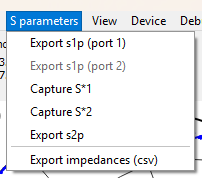
It is possible. nanoVNA V2 Plus4 works nicely with nanoVNA-qt to acquire 1-path 2-port data into Touchstone format when running on a host computer. Those files can be directly used by analysis software.
I don't use it with Matlab but I do this frequently with QUCS-S to analyze and optimize based on measured data. QUCS-S has good interoperability with Octave which generally runs m code like Matlab. I also use it with scikit-rf (Python) in Jupyter Notebook to do time domain transformations, gating, windowing which that rich library supports. I've even implemented TRL calibration that way. Scikit-rf has a lot of flexibility for network manipulation too. It allows embedding, de-embedding and many other useful transforms.
With SAW devices you may not have an issue due to the likely limits on their edge shape and group delay but do be aware that the constant internal self-calibration of the nanoVNA V2 Plus4 puts a limit on how narrow BW, what device group delay, can be measured. See another thread on this forum about that. It may be that there is code that either disables the self cal or slows it down to allow measurement of narrower devices.